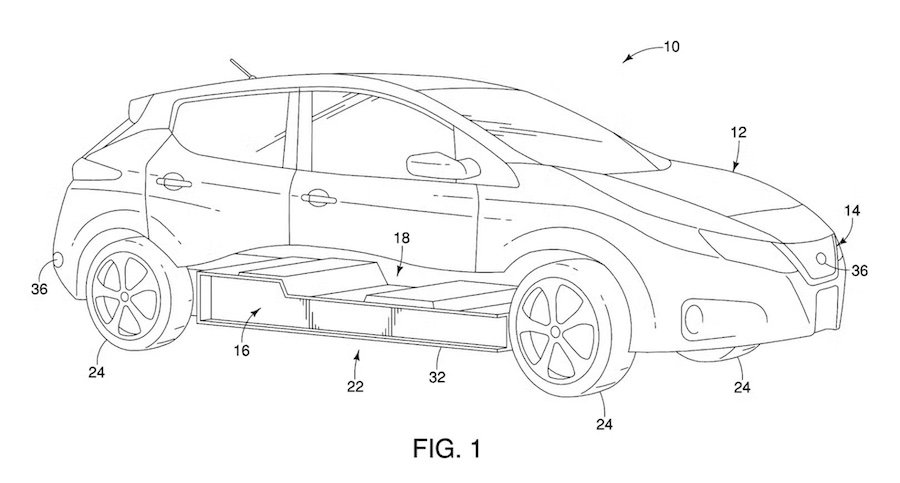
It's a novel technique typically reserved for high-end performance cars from the likes of Mercedes-AMG, but such tech might have applications elsewhere. At least that's what Nissan envisages. CarBuzz discovered a new patent with the USPTO for the equivalent technology for use on EV batteries.
"An EV battery is nothing like an AMG V8," I hear an angry mob screaming, but the two have one major similarity that makes such a patent very interesting. Both are a significant mass located in one area, control over which can vastly improve dynamic vehicle behavior.
The traction battery in an EV is one of its heaviest components, weighing hundreds or even thousands of pounds (the Hummer EV's battery weighs a whopping 2,800 lbs). That's a lot of weight to manage when cornering, and a sudden shift in that weight could easily see an EV overwhelm its tires, and not in the fun way. Nissan's plan to counteract this is to install the battery within a movable case, which has actuators capable of moving the battery left and right and fore and aft.
Turning A Battery Into A Counterweight
The patent was sneakily filed with the title of "Vehicle," but that didn't stop our technical sleuths from finding it. The "vehicle" described by Nissan is an EV, but the documents leave its configuration open to being either a unibody EV like a Leaf or a body-on-frame one like a Frontier or Titan.
The fundamentals of the patent are that the battery, instead of being mounted rigidly, will be mounted within a battery tray, which in turn has actuators capable of moving it fore and aft or left and right.
Basically, anything that can be used to detect the surroundings of a vehicle or detect its handling behavior is fair game. This data is fed into a central computer, which can detect whether the weight balance of the EV needs to be altered. In such a circumstance, the battery tray actuators will push the battery into the ideal position before locking it into position.
What is particularly interesting is the patent specifying a user interface, operable from within the vehicle by either buttons, touch prompts, or voice prompts, to tell the computer when to activate such systems, meaning this would be linked to particular drive modes.
Benefits For Sporty Driving And Beyond
The most obvious advantage of such a system would be to control the weight distribution of a sports car like a Nissan GT-R around a racetrack or twisty road. Nissan acknowledges this, stipulating in the patent that, "The vehicle is provided with the dynamically mounted vehicle battery to enable a less economical and more sporty ride. Therefore, dynamic battery adjustment can be enabled when the vehicle enters a sports mode in which the driver can select a desired vehicle weight distribution during driving."
Basically, by detecting slippage, pitch, yaw, and acceleration, the battery can improve an EV's handling, moving the weight to the inside of the car while cornering, or pushing it to the front or back under acceleration to maximize traction. Think of the Porsche 911 as an example - it's capable of wild acceleration because of the rear-mounted engine pushing the rear wheels into the tarmac. While Nissan could never push the battery out beyond the rear axle, it can shift the vehicle's center of gravity (COG) to get the best possible acceleration.
Expanding Beyond Performance And Into Practicality And Safety
But there are other benefits, too. Nissan doesn't explicitly state what they are, but it continually talks about "those skilled in the art" being able to extrapolate from the data provided and assume varying configurations and applications for such a design. We can think of a few such deviations and applications:
Off-roading - When off-road, particularly on steeply angles ground, being able to shift the center of gravity can prevent vehicle rollovers or help gain additional traction to get out of a sticky spot.
Towing - Weight distribution when towing is vital, not just for safety, but for traction, particularly in a 4WD vehicle. When towing up a steep hill, for example, weight shifts off the front axle, but by shifting the COG forward, this could help maintain traction and allow the front motors of the EV to do more work.
Preventing damaged batteries during accidents - If the sensors detecting the surrounding environment of the vehicle can predict a side impact from a car jumping a stop sign or a red light, the battery could shift to the opposite side of the vehicle to reduce the chances of a damaged battery.
Mitigating rollovers in accidents - EVs are already brilliant at not rolling over because of the battery's low COG, but if a vehicle loses control or is impacted and begins to flip, the battery could shift into a position to help mitigate a rollover further.
Those are just some of the possible implications here, and while sporty handling might seem like a brilliant showcase of such tech - maybe in an electric GT-R as previewed by the Nissan Hyper Force concept, the design is open-ended enough to find numerous applications in future EVs from Nissan and other brands.
