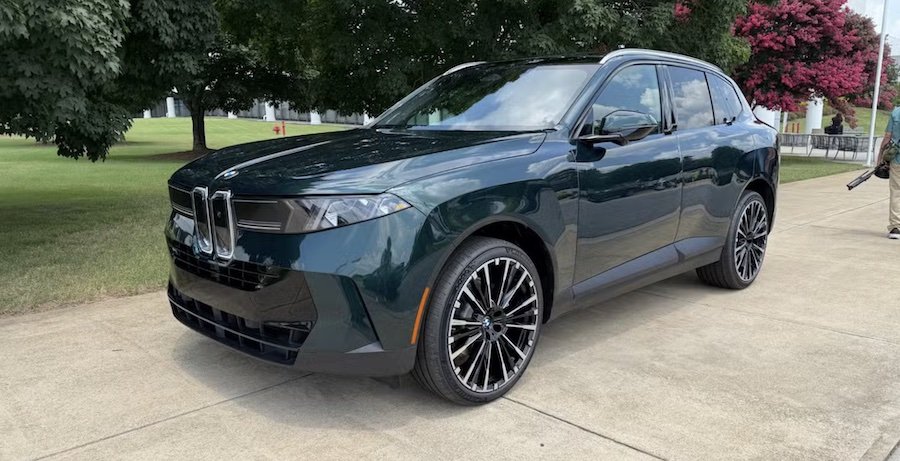
Much more interesting, however, is a new all-electric sibling to the X5, the appropriately named iX5, which arrives with some impressive stats to help the Bavarians do battle against the Audi Q6 e-tron and Mercedes-Benz EQE SUV.
Polarizing? Maybe. Eye Catching? Definitely.
We were surprised to learn that, despite their shared design language with the smaller iX3, the X5 and iX5 are still based on an updated version of BMW's Cluster Architecture (CLAR) platform. But with retro-futuristic styling, we're not sure many customers will care. That starts up front, where a slightly tweaked version of the Neue Klasse narrow kidney grille motif finds a home on a higher, squarer hood profile than has ever been offered on an X5.
Moving to the sides, the beltline is also higher than before, a move that BMW says imparts a stout, monolithic mood. Circular wheel arches live beneath chiseled fender profiles front and rear, recalling both the iX3 and the now-discontinued iX EVs. Around back, the X5 and iX5 take further inspiration from the entry-level iX3 via horizontal taillights with intricate, geometric innards, residing on a beveled tail that places the BMW logo right in the top center of the hatch sheetmetal.
In contrast to its kid sibling, the X5 gets some style all its own via the foursome of X-motif LED lights on the faux grille panel, which BMW says are powerful enough to serve as forward illumination, making separate headlight modules redundant. Furthermore, the door handles have been relocated to little "BMW Winglet" paddles on the beltline trim, keeping those monolithic bodysides unspoiled.
The X5 looks much nicer in person than it does in photos, but that said, we miss the cleaner, purer styling of the outgoing generation. Gone is a quarter-century of X5 design heritage that placed an open, airy greenhouse atop a sleek body shape, punctuated in slanted hatch glass with a separate, swing-down tailgate. The 2027 X5's modern, monolithic shape isn't as immediately appealing as its predecessor.
Posh Goes Techno
The same isn't true once you actuate the switch on those winglets and climb aboard the new Sports Activity Vehicle. The X5 and iX5 again take abundant cues from the Neue Klasse design language, including a BMW Panoramic iDrive pillar-to-pillar dashboard display that places pertinent driving information right at the base of the windshield for easy visibility. The dash shape is a little unconventional, but the instrument cluster location makes a head-up display redundant and provides for a less bulky dashboard, improving the perception of space.
The 17.9-inch "free cut display" on the center stack handles more commonly used infotainment duties, including audio, navigation, and infotainment controls. It sits beside the automaker's new, avant-garde steering wheel with two vertical spokes and robust hand-holds on the 9 and 3 o'clock positions, while an optional 14.6-inch high-def display appears in front of the passenger for co-pilot and private entertainment duties.
BMW paid very special attention to the materials inside the 2027 X5 and iX5, with a novel and rich-feeling slate panel appearing on the center console as a housing for the tumbling volume knob and other frequently used physical buttons. The slate can also be combined with genuine glass controls with the BMW Individual Clear & Bold package, giving the cabin some crystalline embellishments.
A variety of Veganza faux leather and genuine Merino leather upholstery options are on the menu, and the fake hides aren't just limited to lower models – BMW Veganza is worth experiencing before ticking the extra-cost box for leather. The front and rear seats have been reshaped and now have a more lounge-like appearance, borrowing a note from the aforementioned iX and polarizing XM sport-utes.
Those looking for gizmos and gadgets will want to add the optional Luxury package, which includes a quartet of power-operated passenger doors, which open automatically with the key fob, vehicle app, or with the winglet door handles. The doors shut automatically using the same methods, although stepping on the brake in anticipation of getting on the way will also close all four at the same time.
Possibly the biggest news of the new generation is the arrival of the iX5, which trades BMW's iconic inline-six for a sizable 144-kilowatt-hour battery and a pair of electric motors. Estimated range for the SUV is an impressive 435 miles per charge, and those who take frequent road trips will be delighted to learn that the iX5 is capable of 460-kilowatt DC fast charging, which will make it the fastest-charging EV on the market today.
2027 BMW iX5 vs. Competitors | |||
|---|---|---|---|
2027 BMW iX5 60 xDrive | 2027 Audi SQ6 e-tron | 2026 Mercedes-AMG EQE SUV | |
Output | 570 hp / 593 lb-ft | 509 hp / 631 lb-ft | 617 hp / 701 lb-ft |
Range | 435 miles | 285 miles | 230 miles |
Max DC Charge Rate | 460 kilowatts | 270 kilowatts | 170 kilowatts |
Price* | $81,250 | $74,495 | $98,750 |
*incl. destination | |||
That impressive range and charging performance come courtesy of a battery pack with Gen6 cylindrical cells instead of prismatic ones on older BMW designs. The configuration allows for greater energy density, and the larger iX5 takes advantage of its size by using 120-millimeter-high cells instead of the iX3's 95-mm units. They don't need to be arranged in modules, allowing the cells to be integrated directly into the battery pack, another weight-reducing, density-increasing design feature. That said, the iX5 doesn't make use of the Neue Klasse platform's pack-to-open-body design, which would make everything even lighter and improve body rigidity.
The 800-volt battery sends marching orders to a pair of motors – one for each axle – that produce a combined total of 570 horsepower and 593 pound-feet. Zero to 60 miles per hour happens in 4.4 seconds, although we predict that number is typically conservative; a time in the threes seems likely.
The primary drive motor is an electrically excited synchronous unit mounted to the rear, which ditches permanent magnets in favor of a stator and electromagnets for more precise operation, reducing power losses at low speeds and improving response in sporty driving. The front motor is an asynchronous unit, and since it uses induction instead of magnets, it can be switched off to create zero drag loss when the added traction or power isn't required.
2025 BMW X5 Engines: Signature Six-Cylinder
BMW has announced two different internal combustion powerplants, with the 40 xDrive serving as the base configuration. It produces an impressive 394 hp and 428 lb-ft from its turbocharged 3.0-liter inline-six, a highly updated version of the legendary B58 engine family that now runs on the Miller cycle and features a cast-in-head exhaust manifold for better thermal efficiency and weight reduction.
A starter generator integrated into the eight-speed automatic runs on a 48-volt mild-hybrid electrical system, providing the X5 with smoother automatic stop-start operation and sharper responses when accelerating. As its name suggests, the starter generator charges the medium-voltage battery during braking or coasting, recapturing energy that would otherwise be lost to heat.
A Plug-In Hybrid Alternative
If you'd like more advanced electrification but aren't ready to commit to an EV, the plug-in hybrid BMW X5 50e xDrive may be the ride for you. Its 3.0-liter six is detuned to 308 hp, but a synchronous electric motor in the transmission raises combined output to 483 hp and 516 lb-ft. A 26.5-kWh battery in the floor allows the PHEV to travel 44 miles per charge, a 15 percent improvement from the previous-generation X5 plug-in.
BMW quotes an estimated 0-60 time of 4.6 seconds in the 50e, an improvement from the 40's 5.1 seconds – again, we suspect both numbers are pessimistic.
Hydrogen Power Is On The Way
BMW took the opportunity to announce the iX5 Hydrogen fuel-cell vehicle as well, and although details are scant, it will be the automaker's first series-production fuel-cell electric vehicle. The iX5 Hydrogen is based on the battery-electric model, and although BMW didn't confirm it, we suspect it'll be a plug-in model that provides a few miles of battery-powered propulsion before the fuel cells fire up to generate electricity.
Never Out Of Control
Irrespective of powertrain, the X5 receives standard adaptive dampers and a familiar double-wishbone front suspension and five-link rear axle. A wider track, standard staggered tires, and body structure rigidity improvements should provide more responsive handling. An optional air suspension has 1.6 inches of variable ride height (0.8 inches lower or 0.8 inches higher, depending on drive mode) for both improved aerodynamics and ground clearance.
The iX5 and X5 PHEV also come standard with active roll stabilization, as well as four-wheel steering. At low speeds, the rear axle turns out of phase with the front axle by up to 3.2 degrees, reducing the turning circle by more than 2 feet. Once you hit the road in earnest, the rear wheels turn in phase with the fronts for better stability.
Advanced Electronics And Active Safety
Although not based on the Neue Klasse platform, the iX5 still benefits from its advanced Heart of Joy electronic architecture. Heart of Joy has fewer body, suspension, and powertrain control modules than competitive electric cars, meaning reduced weight and quicker responses from the computers. The combustion X5 retains its predecessor's control unit network.
Both cars benefit from BMW Symbiotic Drive active driver assistance, an advanced Level 2 system with artificial intelligence, which should provide gentler corrective action and allow the driver to accelerate, brake, or steer without deactivating the system. The electronic brain can interpret the driver's attention level and vehicle inputs to determine if an action is intentional, allowing the driver to take control momentarily before the system seamlessly reactivates.
The X5 family also offers Highway Assistant, which allows for hands-free driving at speeds up to 85 percent, provided the driver pays attention to the road ahead. The neatest feature – assuming it works as intended – is Active Lane Change with Eye Activation. As the X5 approaches slower-moving traffic ahead, it can recommend a lane change, and all the driver needs to do is glance toward the appropriate side-view mirror to confirm it.
Price & Launch Date: The X5 Arrives This Autumn
The 2027 BMW X5 launches in 40 xDrive form in October, with a starting price of $72,100 plus $1,450 destination. Early next year, a rear-drive X5 40 arrives with a $69,800 base price, while the forthcoming X5 50e plug-in hybrid will demand $77,500. At the top of the heap is the iX5 EV, whose $79,800 starting price splits the difference between the substantially less powerful Audi SQ6 e-tron and the faster (but shorter-legged) Mercedes-AMG EQE SUV.
The Bavarians will also put a V8 in the X5 with a forthcoming M Performance model, although they haven't specified when or in what form that vehicle will arrive. The same is true of the iX5 Hydrogen.
